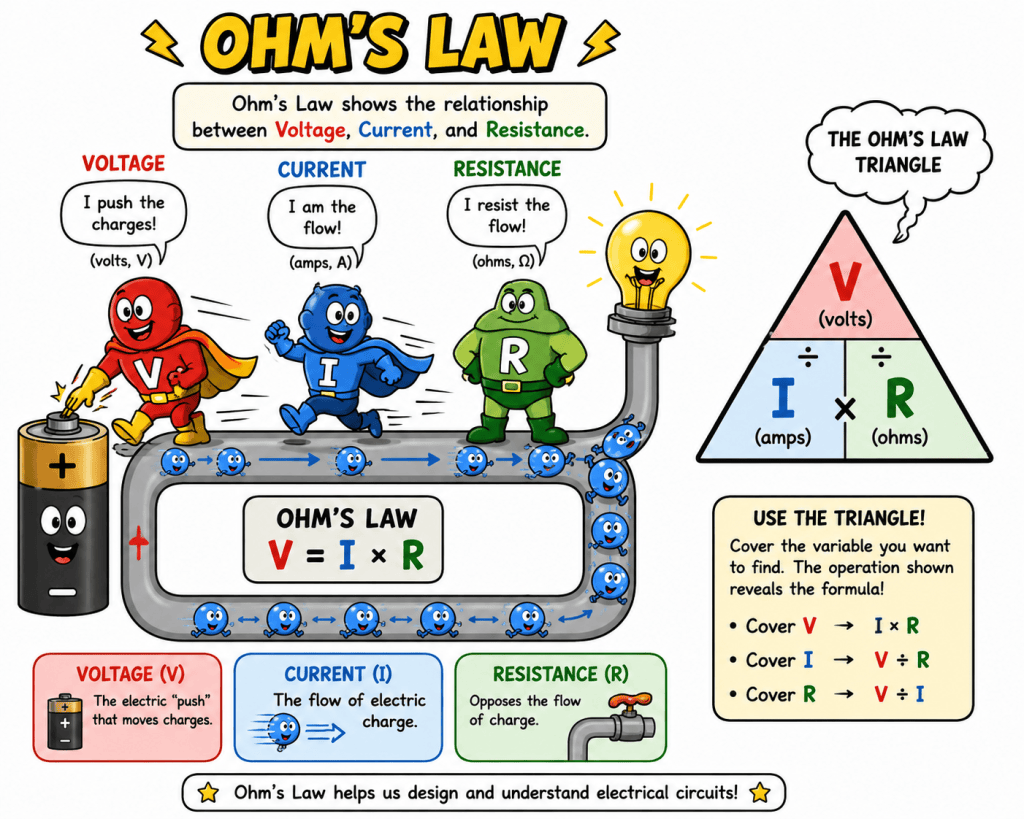
Ohm’s law as taught in schools is making it confusing and harder for students to understand it. Ohm’s Law looks simple on the surface, but it becomes confusing because the math hides the physical meaning. The equation appears simple algebra. The formula (V = I × R) looks like basic algebra, but students often miss what each variable really means.
Math makes nature seem simpler than it really is. Students get stuck on rearranging formulas. Students are told I = V / R, R = V / I, and V = IR.
It feels like “three different rules,” when it is one relationship written in three ways. This creates confusion like “Am I solving physics or just shuffling symbols?”
The common V-I-R triangle helps with quick calculation, but it causes problems and creates misunderstanding. Students memorize positions instead of understanding. They forget why division or multiplication is used. It turns physics into pattern-guessing.
Math does not show direction of cause. For example, does voltage create current? Or does current create voltage drop? The equation does not explain the mechanism, only the relationship. This is where learners feel “I can calculate it, but I don’t understand it.”
The deeper issue is math is static but reality is dynamic. The equation is a snapshot model, but real circuits are time-dependent, temperature-dependent, and material-dependent. The mismatch between a clean equation and messy reality creates confusion.
The old traditional way of teaching Ohm’s Law is often based on a water-flow analogy and simple circuit experiments. Imagine electricity flowing like water. Voltage (V) is the water pressure pushing the flow. Current (I) is the amount of water flowing. Resistance (R) is the narrowness or blockage in the pipe. A higher pressure pushes more water. Similarly, higher voltage pushes more current. The old teaching method treated current almost like water flowing through a pipe.
Modern physics explains more deeply where voltage creates an electric field. The electric field causes electrons in the conductor to drift. Resistance comes from electrons interacting with the atomic structure of the material.
The old analogy is useful for learning, but the quantum picture explains why resistance and current exist. Quantum physics and electrical current are deeply connected because electricity at its most fundamental level is governed by quantum behavior of matter and particles.
Electrical current is the movement of electric charge. In metal wires, the moving charges are mostly electrons. In a simple circuit a battery creates an electric field. The field pushes electrons through the conductor. This movement of charge is the current.
An electron is not just a tiny classical ball orbiting a nucleus. Quantum physics tells us that electrons have wave-like properties, quantized energy levels, and probabilistic behavior.
Inside atoms, electrons occupy specific quantum states. When many atoms form a metal, their outer electrons become less tightly bound and can move through the material.
A copper wire works because of the quantum structure of copper atoms. Copper has one loosely bound outer electron. These electrons form a shared “electron sea” through the metal. An applied voltage changes the electron motion, creating current.
The electrons do not race from the battery to the load or device instantly. The electric field propagates through the circuit very quickly, while the electrons drift slowly.
That is why the light bulb lights up instantly when switch is flipped.
Modern electronics depend on quantum physics. Transistors work because electrons can be controlled by quantum energy bands. Semiconductors depend on quantum band gaps. LEDs and lasers work through quantum transitions. Solar cells convert photon energy into electrical current through quantum processes.


Leave a comment