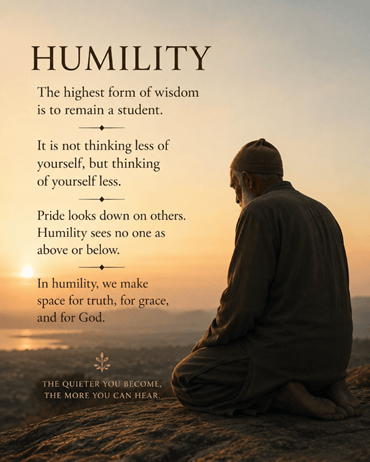
Humility is the quiet recognition that we are not the center of the universe and more importantly that we do not need to be.
It does not mean thinking poorly of yourself. Rather, it means seeing yourself truthfully. Knowing your strengths without becoming proud of them, accepting your limitations without shame, and remaining open to learning from others.
In Sufi thought humility is intricately connected with surrender and the weakening of the ego. The Sufi does not seek to destroy the self, but to loosen its insistence on “I, me, and mine.”
A person may think “I did this. I achieved this. I know this.”
Humility quietly changes the question to “How much of what I have is truly mine?”
Your knowledge came from those who taught you. Your abilities were shaped by circumstances you did not create. Your life itself was given to you. Even the breath you take is not something you command completely. This realization can produce gratitude rather than pride.
In many mystical traditions, the ego creates a wall between the individual and the Divine. The more tightly we hold onto our image of ourselves, the harder it becomes to see beyond ourselves.
Humility creates an opening. It says, “I may not know.”
And sometimes those four words are the beginning of wisdom.
There is a beautiful paradox here. The more a person recognizes how little they know, the more deeply they may begin to understand. In my book The Mystery We Call God, available at Kindle Direct Publishing on Amazon, humility is present as an important part of the search for God. We cannot approach an infinite mystery with the certainty that we have already understood it. The seeker bows not necessarily because he has found all the answers, but because he has finally recognized the vastness of the question.


Leave a comment